
Choking on Hope
The one evil Pandora did not let into the world

Hope against hope.
Hope springs eternal.
Abandon hope, all ye who enter here.
Cross my heart and hope to die.
If you watched the Jeopardy episode that aired on October 3, 2022, you would have seen this clue, “This was all that was left after Pandora opened her box releasing all the evils into the world.”
In Greek mythology, Pandora was the first woman Zeus created. Being molded from clay must have been a tough start to life, especially when your reason for existing is as punishment for the actions of another god, namely Prometheus’ theft of fire. It is no wonder Pandora’s self-esteem was so low. So after being given a box containing all the evils of the world and ordered never to open it, naturally she opened it. And all the evils escaped into the world, including pain, disease, war, vice, toil, sickness and death — all the evils, that is, except one. She managed to close the box with one remaining evil left inside. That evil? It was “hope.”

Written over 2700 years ago, the story of Pandora suffers from the challenge of interpreting original meaning. Among the possible translations for this particular final evil is “deceptive expectation,” though that doesn’t exactly roll off the tongue or sit well on the page. No doubt the Jeopardy judges would have been more than puzzled if a contestant gave “What is deceptive expectation?” as their answer instead of answering, “What is hope?”
Pandora’s unreleased evil of “hope” is the modern English equivalent of “deceptive expectation” — a way of pointing towards some moment in the future when a problem has been solved, all the while knowing that the odds against that future are astronomical. Hope is a way of challenging our perceptions of reality and replacing them with a gaslit delusion. Hope keeps us locked away inside the depths of Plato’s Cave. Hope forces us to live inside the matrix where we are never offered the “red pill.” Hope means being shut off from learning the most profoundly eye-opening and life-changing truths.
Politicians, doctors, religious figures, entrepreneurs, revolutionaries and sociopaths all preach deceptive expectations. For a better tomorrow, a wall to keep them out, social justice for all, a chicken in every pot, a cure for cancer, the deaf to hear, better sex, a longer life, to kick addiction, lose weight or get a great deal on a car. Above all, a deceptive expectation to create a new society where nature is respected as a partner on the planet and all humans live bountiful, just and equal lives. You would think this crush of deceptive expectations would sooner or later make us realize the massive delusion that is known as modern industrial civilization. Instead, to live in modern society is to be deceived by expectations that we pay for with our most precious possession, our short time on this planet as living conscious beings.
And Pandora’s “hope” leads to a paradox. Hope means understanding our powerlessness in a situation. It means trusting that some other individual, group or spiritual entity will take an action that we are unequipped or unprepared to take ourselves. If we knew what to do and could do it, we wouldn’t need hope. No one hoped the great pyramids into existence. It wasn’t hope that invented the internal combustion engine, fracking, cigarettes, whiskey or industrial farming. Hope didn’t write this blog post or make my morning coffee. Action doesn’t require hope and hope isn’t action. Hope can’t do a damn thing. When we hope, we are really hoping something happens so that we no longer need hope. We hope to have no hope. Hope is an ouroboros, a snake that eats its own tail.
The current rhetoric surrounding climate change and collapse is filled with hope manifested as deceptive expectations: that humanity will keep global temperature change below 1.5C, 2.0C, or wherever the goalposts are currently set; that humanity will bring down anthropogenic methane by 30% by the year 2030; that green energy solutions like solar, wind, geo-thermal and nuclear will replace fossil fuels; that new technologies to sequester carbon dioxide, to produce clean hydrogen, to re-freeze the Arctic are just around the corner; that we will achieve re-forestation, soil regeneration, climate justice and de-growth; that humans will somehow save the planet over the next years and decades.
I want to share a few uses of “hope” by some climate scientists with you, so you can more easily see just how deceptive they are.
First, as Michael Mann expressed it, “hope” can mean that the error bar in the climate simulations still allows for outcomes where humanity survives the apocalypse:
“I can say in good faith that the science does indicate that there is still hope for averting the worst impacts. And because of that, it would be so tragic if we fell into doom and despair at the very moment where we most need to act.” — Michael Mann
Mann has often expressed his belief that doomers are unwitting pawns of the fossil fuel industry, that their message of doom and despair resulting from their feelings of hopelessness lead them to a harmful call for “inactivism.” I disagree.
If we understand hope as deceptive expectation, then the opposite of hope must be “reasonable expectation.” In other words, the opposite of hope is a view of the future based on a full understanding of the present, including all the available science, deep knowledge of history and human nature, and an honest assessment of what is possible given the current political, social, geophysical and monetary constraints on action. Hopelessness is an entirely different concept — it is existential angst, a type of depression that arises from knowing we are born to die and our lives are ultimately meaningless. Finding personal meaning in the face of a finite existence on a very small planet has very little if anything to do with collapse or climate change.
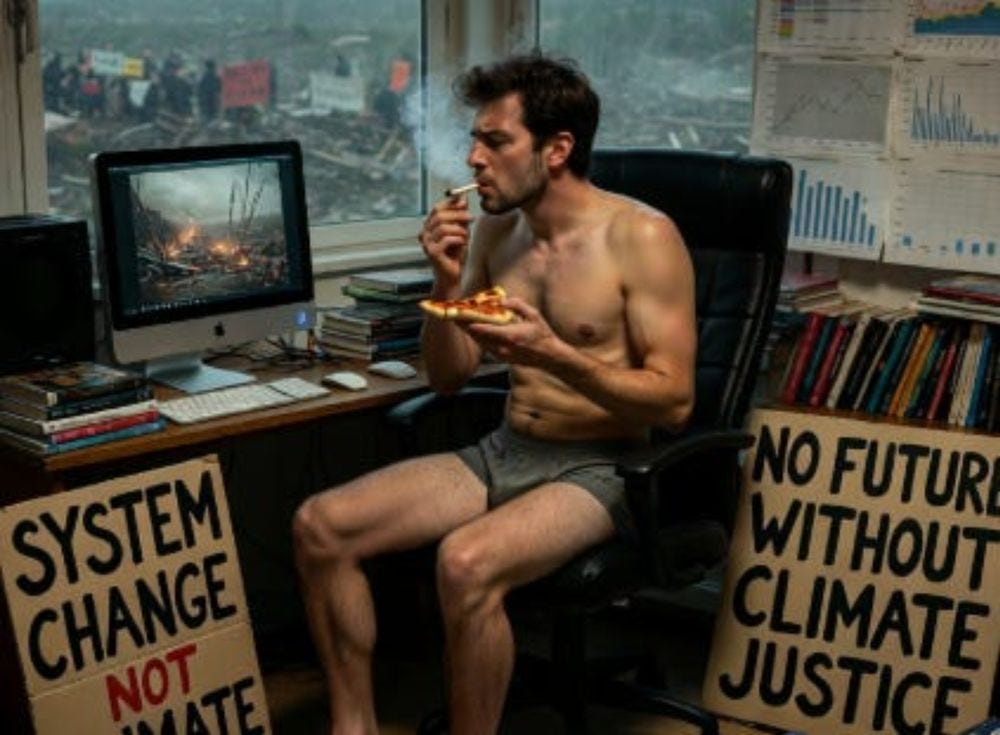
Creating a meaningful life and finding ways to be proactive environmentally is not the same as having hope. Hopelessness does not imply inaction. It is simply incorrect to suggest that doomers are inactivists, that they spend their waking hours sitting in front of a computer in their underwear, smoking joints and eating pizza, while ignorantly mocking climate scientists for not stating how fucked we really are. To me, being a doomer means being an activist, just with more reasonable expectations. And plenty of climate scientists are stating how fucked we are. Case closed.
Next up, climate scientist Katharine Hayhoe wrote a recent book with the word “hope” in its title, Saving Us: A Climate Scientist’s Case for Hope and Healing in a Divided World. At least she’s letting us know her intentions are to deceive right up front and her methodology is quite seductive.
“But hope is that faint, small, bright light at the end of the dark tunnel that we head for with all our might and all our strength. And when we get dragged down, when we get discouraged, when we get anxious and depressed…we take a breath, we fix our eyes on that hope… What’s at stake is literally us.” — Katharine Hayhoe
Other than writing in a style that resembles a football coach’s locker room speech before the big game, I am not sure what any of this means. How does focusing on a light that doesn’t exist at the end of an imaginary tunnel keep the coral from dying, the AMOC from collapsing, or any number of other tipping points from tipping?
And finally, as Will Turner says, it’s fine to be an inactivist, just make sure you are a scientifically justified and hopeful inactivist.
“At this point, inaction due to uncertainty is scientifically unjustifiable, and inaction due to hopelessness is indefensible. We can still make a difference, but we must act now.” — Will Turner
Going forward, whenever you see the word “hope” used in the context of collapse or climate change, replace it with “deceptive expectation” and re-read the passage. Consider what your reasonable expectations are for the situation and base your activism on reality. Understand how you are being lied to, gaslighted and manipulated to stay inside the delusion.
Hope is not a good thing. Hope is not something to wish for yourself, others or the planet. It is perhaps the most evil of all the evils, so much so that even the innocent and curious Pandora was wise enough to not release it. And yet here we are, 2700 years after Pandora opened the box, on a dying planet, in the last great days of modern human civilization. Here we are, hoping to avert the worst impacts of collapse, hoping to see that faint, small, bright light at the end of the dark tunnel, hoping for “hope” to have meaning, hoping to not be hopeless, hoping for someone to tell us there is no hope.
*This essay was inspired by Sam Mitchell and a tweet from the X account “Collapse Aphorisms.”
Never much liked Michael ("you can't handle the truth!") Mann. If you want it straight James Hansen's the guy.
I’m still hoping that we make deep, drastic, and permanent reductions in CO2 emissions starting in 2019, like the IPCC models say we need to. 🤞 C’mon, baby, that window is almost closed!